Autonomous Surface Vessel
This US Coast Guard Academy capstone project centers on building and programming a self-driving boat to compete in the six unique challenges of the RoboNation RoboBoat competition. Our team is exploring how advanced sensors like GNSS, IMU, LiDAR, cameras, and hydrophones can help vessels navigate safely without a human pilot. By using this technology to automate difficult tasks at sea, we aim to show how the Coast Guard can eventually reduce human error and keep sailors out of harm’s way during dangerous missions.
RESEARCH CONTEXT
The maritime sector is currently experiencing a surge in autonomy as developers seek safer and more efficient operational solutions. RoboNation’s RoboBoat competition serves as a critical testbed, challenging vessels to complete six fully autonomous tasks in a dynamic aquatic arena. To advance this research, the ASV project is passed down through successive capstone teams who continuously refine and upgrade the existing hull and hardware suite.
The Coast Guard relies on autonomous technology to protect crews by keeping them out of harm’s way during dangerous missions. Using self-driving boats helps reduce human error while improving our ability to navigate in low visibility or heavy storms. These robotic systems are essential for critical tasks like search and rescue and law enforcement, ensuring safer and more effective operations on the water.
System Design
Catamaran Hull
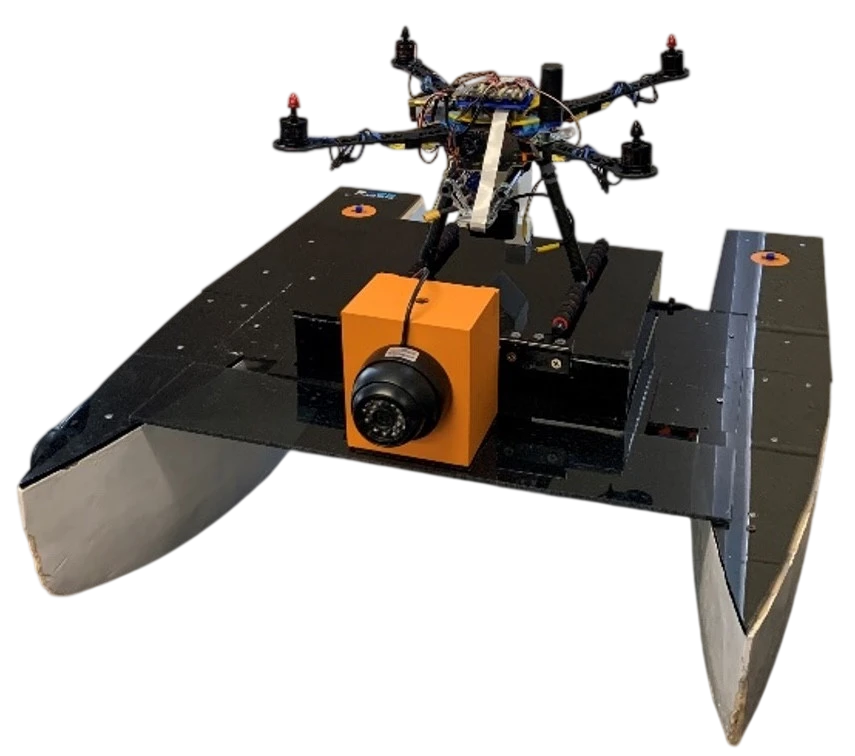
Our specialized twin-hull design significantly enhances stability by reducing roll and pitch, which ensures clean, highly accurate sensor readings. The expanded deck surface accommodates an extensive sensor array and a dedicated UAV landing pad. To maintain operational integrity, we integrated a custom watertight electronics box that fully protects critical hardware from the aquatic environment.
Propulsion & Power
The vessel utilizes two Blue Robotics T-200 thrusters driven by ESCs for high-performance motion. Power is supplied by dedicated 14.8V batteries equipped with relays and thermal protection to maintain system integrity. By employing differential thrust instead of a traditional rudder, the boat can execute incredibly tight turns and spin in place for superior agility.
Onboard Compute
Autonomous operations are driven by a UDOO Bolt V8 processing unit running high-level autonomy software, while an integrated Arduino Leonardo manages low-level motor control and the PD controller loop. This hardware split ensures the vessel reacts almost instantly to sensor data through the dedicated microcontroller. Meanwhile, the primary processor handles resource-intensive tasks such as path planning and real-time image processing without degrading control stability.
Integrated Sensor Suite
Our vessel utilizes a multi-modal sensor array where GNSS and IMU provide precise global positioning and heading, while LiDAR scans the environment for obstacle detection. A high-resolution camera enables visual buoy recognition, and a specialized hydrophone facilitates autonomous acoustic docking. By fusing these diverse data streams, the system builds a comprehensive situational awareness that allows the ASV to navigate complex maritime landscapes safely.
- LiDAR for 360° obstacle detection
- IMU & GNSS for precise positioning
- Stereo Camera for visual navigation
- Hydrophone for acoustic docking
- RF Safety Kill-Switch system
CONTROL LOGIC
The PD heading controller utilizes real-time IMU data to produce smooth, incremental thruster adjustments that keep the vessel steadfast on its intended bearing. Using a UAV-generated map and precise GNSS waypoints, the system executes a sophisticated box-pattern course with high accuracy. As the ASV nears each target coordinate, the controller dynamically fine-tunes both speed and heading to ensure a stable and controlled approach to every milestone.
Our navigation system fuses LiDAR and camera data to accurately detect and classify buoys and obstacles in the water. To ensure precision during the final stages of a mission, a hydrophone array listens for specific acoustic pings to guide the vessel into its docking station. By integrating these diverse sensor streams, the ASV successfully avoids collisions and completes complex RoboBoat tasks entirely without human input.
Systems & Hardware
Our Autonomous Surface Vessel is built on a stable catamaran hull with two slim hulls joined by a rigid frame. This design reduces roll and pitch so the sensors get cleaner data, and it provides a wide deck area for mounting equipment. In the center, a watertight electronics box protects the onboard computer, power distribution, and other sensitive hardware from water damage while still giving easy access for maintenance.
For propulsion, the ASV uses two Blue Robotics T‑200 thrusters driven by electronic speed controllers (ESCs). The thrusters are powered by dedicated 14.8 V batteries that include thermal protection and safety relays so power can be cut quickly in an emergency. Instead of a rudder, the vessel uses differential thrust, meaning each thruster can spin at a different speed. This lets the boat turn sharply, spin in place, and maneuver precisely in tight spaces.
At the heart of the system is a compact UDOO Bolt computer paired with an integrated Arduino Leonardo. The UDOO runs the high‑level autonomy software, such as path planning and image processing, while the Arduino handles low‑level motor control and the PD (Proportional–Derivative) controller. The PD controller reads the vessel’s heading and adjusts the thrusters to keep the ASV on course.
- GNSS (GPS) – gives the vessel its position and allows waypoint navigation.
- IMU (Inertial Measurement Unit) – measures heading and motion so the controller knows which way the boat is pointing.
- LiDAR – scans the area around the vessel to detect obstacles and measure distances.
- Camera – captures images so the system can recognize buoys and other objects by color and shape.
- Hydrophone – listens for underwater acoustic signals that guide the vessel during docking tasks.
Together, this hardware and sensor suite forms a flexible platform for testing and improving autonomous behaviors on the water.
Future Work & USCG Impact
Future development will prioritize refining the ASV’s precision through improved IMU calibration and tighter waypoint tracking. We plan to deploy more advanced computer vision and high-fidelity LiDAR mapping to enhance situational awareness. Additionally, full integration of acoustic docking will ensure the vessel is fully reliable and competition-ready for complex mission tasks.
These ASV capabilities serve as vital force multipliers for Coast Guard cutters, executing search and rescue, drug interdiction, and migrant intercept missions alongside manned crews. By operating autonomously in heavy seas and low visibility, these vessels significantly reduce the danger faced by personnel during high-stakes maritime law enforcement. This technology allows the USCG to maintain a persistent presence across vast areas while removing sailors from the most hazardous environmental conditions.
Testing & Results
Float Tank
Initial buoyancy tests verified hull stability and weight distribution. Results showed balanced trim with all systems powered.
Pool Trails
Controlled environment testing for the PD controller. The 90° heading step response showed precise turning with minimal overshoot.
Thames River
Real-world box-pattern waypoint tests proved successful GNSS navigation. The system maintained accuracy despite river currents.
Static stability was verified in the float tank, followed by pool trials that refined the PD controller’s 90° heading step response and mitigated turn overshoot. During Thames River testing, the ASV successfully executed box-pattern waypoint navigation while maintaining a 10 m threshold against real-world currents. While results confirm a robust foundation for autonomous maneuvers, data highlighted the need for improved IMU calibration and further overshoot reduction in future iterations.
Download
Access the final capstone report and research poster PDFs to explore the complete technical details of the maritime autonomy project.